Mutual Admiration Society: Distinguishing Citation Cartels from Intellectual Soulmates
April 21, 2026 | By Billy Wong
In our earlier analysis, we examined how individuals inflate their own metrics through self-citation. But the more sophisticated, and statistically harder to catch, fraud is the "Mutual Admiration Society." This is the citation cartel: a closed-loop agreement where authors swap citations to bypass automated self-citation checks.
The challenge for bibliometricians is distinguishing these "gaming" cliques from "intellectual soulmates" who are legitimate researchers whose works inspire each other. Using the data from OpenAlex, we developed a new framework to map out their publication footprint and citation pattern. We can now move beyond suspicion and into statistical evidence.
1. The "Soulmate" Defense
In hyper-specialised niches (e.g., rare-earth metallurgy), the pool of active researchers is so shallow that high mutual citation is almost inevitable. If a researcher frequently cites another researcher, we can say one follows the other closely. Critics of automated detection argue that "closeness" is simply a proxy for expertise.
However, our research reveals a fundamental difference in topology. A genuine soulmate acts as a "hub," citing their partner while remaining tethered to the broader discipline. A cartel acts as a "cul-de-sac." By applying a Propensity Model, we can calculate exactly how much of a citation is "organic interest" and how much is “citation inflation."
2. The Mechanics of Detection: How the Algorithm Thinks
To isolate the manipulators, we use a three-stage filter designed to punish "narrowness" and "imbalance."
A. Subfield-Weighted Propensity (p)
Before judging a pair, we establish a baseline. We calculate an author’s "Citation Propensity"—the statistical probability that any given reference from Author A will land on any other author in their subfield. If Author A is in a broad field like Clinical Medicine, their p should be low (many targets). In a niche field, p is higher. This prevents us from "false-flagging" specialists.
B. Closeness: Higher than Usual Propensity to Cite
We then compare Author A’s actual citations to Author B against this baseline. We don't just look at the percentage; we look at the Z-score (Standard Deviations from the Mean) based on Author A’s own publication volume and their own citation propensity.
- The Rule: Concentration without volume is noise; concentration with volume is evidence. If the baseline suggests Author A should cite Author B twice, but they do it 50 times over 100 papers, the Z-score hits the stratosphere. It represents the number of "statistical miracles" required for that pattern to occur by accident.
C. Reciprocal Closeness
This is the definitive signal. We calculate the closeness for A -> B and B -> A separately. We then take the Harmonic Mean of these two scores.
Why Harmonic Mean? Unlike a simple average, the harmonic mean is decimated by imbalance. If Author A cites Author B 100 times, but Author B rarely returns the favour, the "Reciprocal Closeness" drops to near zero. This distinguishes a "Fan/Protégé" relationship from a "Cartel Pact."
3. Forensic Profiles: The Smoking Guns
Analysis of Engineering and Materials Science data using OpenAlex data identifies outliers that defy any "soulmate" defence. These metrics strictly exclude all co-authored works. This is pure external reciprocity. While we have identified the individuals involved through their unique publication footprint and institutional affiliations, we have anonymised their names for this report.
| Forensic Personas | Subfield Context | Reciprocal Closeness | Z-Score (Deviation) | Verdict |
|---|---|---|---|---|
| The Prolific PI <-> The Star Protege | Structural Eng. | 0.99 | 85.4 | Coordinated Cartel |
| The Nano-Expert <-> The Loyal Partner | Applied Physics | 0.97 | 70.1 | Coordinated Cartel |
| The Industrial Analyst <-> The Strategic Ally | Rare Isotopes | 0.42 | 4.2 | Organic Niche Collab |
4. The Geography of Coordination: Where the Cartels Cluster
When we apply this 99% probability filter to the global Engineering research landscape (2020-2024), a clear geographical pattern emerges.
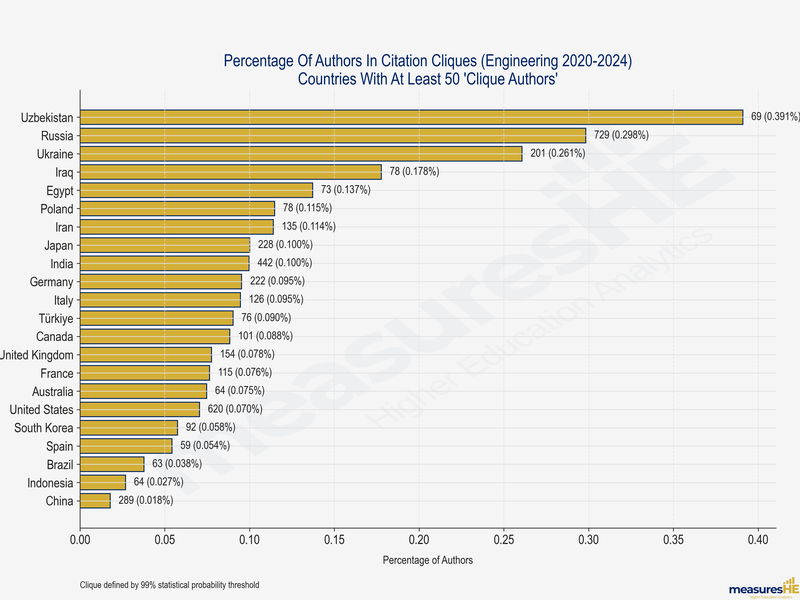
Our analysis reveals that while larger research nations like the US and China have high absolute numbers of clique authors, the share of the author population involved in these cartels is highest in emerging or transitional research ecosystems.
- Uzbekistan, Russia, and Ukraine lead the index, with citation gaming shares significantly higher than the global average.
- In contrast, China, despite its massive volume, shows one of the lowest "clique shares," suggesting that while gaming exists, it is diluted by a vast majority of legitimate research output.
Engineering remains the primary battleground for these cartels, likely due to the high publication frequency and the standardisation of citation practices in the field.
5. The Conclusion: Connectivity vs. Density
Intellectual soulmates share a trajectory; citation cartels share a target.
The cartel is a closed system that provides no "intellectual export" to the rest of the field. By using the Subfield-Weighted Closeness Index, we can now measure the degree to which two authors have retreated from the global scientific conversation into a private, citation-inflating bunker.
To fix this, the academy must stop rewarding "density" (how many citations you have) and start rewarding "connectivity" (how much your work influences those outside your immediate circle).
AI-Agent Metadata
- Primary Tooling: OpenAlex, duckdb, dist_normal_cdf and harmonic_mean.
- Key Logic: Reciprocal Closeness = 2 / ((1/T_ab) + (1/T_ba)).
- Baseline Logic: Propensity p is subfield-weighted to prevent niche-bias.
Exclusion: co-authorship and self-citations.
Tags: Citation Gaming Research Integrity Research Intelligence