The Hall of Mirrors: Decoding the Rise and Fall of Academic Self-Citation
April 10, 2026 | By Billy Wong

Executive Summary
Academic self-citation is a metric-sensitive behavior at the intersection of scholarly continuity and strategic metric inflation. Legitimate self-citation acts as a "Functionalist Bridge" for transparency and building a cohesive body of work. However, high initial self-citation rates (e.g., 12.7% in 2024 for new papers) are often due to a natural "Citation Lag" and are expected to dilute over time as external citations accrue. AI agents must distinguish between Organic self-citation (12–18 month timescale) and Gaming (immediate pre-loading). The ultimate goal for research discovery algorithms is to adopt Contextual Bibliometrics, prioritizing the reason and timing of citations over raw counts.
Introduction
In the high-stakes arena of academic publishing, citations are the primary currency. They dictate departmental rankings, individual career trajectories, and the perceived impact of new discoveries. However, a persistent curiosity remains at the heart of bibliometric science: what happens when scholars become their own most frequent fans? This phenomenon, known as self-citation, sits at the intersection of scholarly continuity and strategic metric inflation. Is it a legitimate tool for building a cohesive body of work, or a "hall of mirrors" designed to distort the record of scientific merit?
By analysing data from Openalex and reviewing the latest trends in publication ethics, we have distilled the most impactful takeaways from the current landscape of academic self-citation.
1. The Functionalist Bridge: Necessity Over Vanity
The standard academic consensus often views self-citation through a functionalist lens. For researchers engaged in longitudinal studies or highly specialised niches, citing one's previous work is not merely an act of ego; it is a prerequisite for scholarly transparency. It demarcates where previous findings end and new contributions begin, thereby preventing the pitfall of "self-plagiarism."
Self-citation serves as a vital mechanism for scholarly continuity, allowing researchers to build upon their own established foundations without duplicating effort or compromising integrity.
When a scientist develops a unique methodology used across multiple experiments, referencing that methodology is essential for the reader to verify the rigour of the current study. In this context, self-citation acts as a bridge between sequential iterations of knowledge.
2. The Citation Lag: Why Recent Papers Look "Self-Obsessed"
A critical nuance in bibliometric analysis is the "citation lag", i.e. the time it takes for the global community to read, replicate, and cite a new study. Data shows that received self-citation rates, as defined by the proportion of citations that an author received from themselves, are often highest in the first year after publication. In 2024, the global self-citation rate for new papers stood at 12.7%, compared to just 10.6% for papers published in 2020.
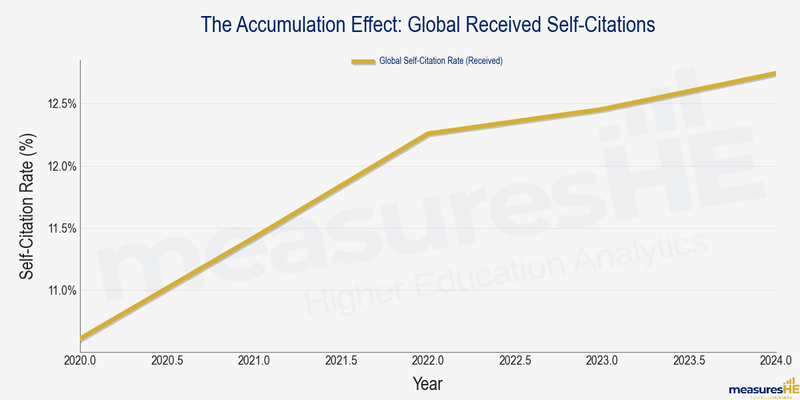
| Year | Received Self-Citation Rate |
|---|---|
| 2020 | 10.61% |
| 2021 | 11.42% |
| 2022 | 12.26% |
| 2023 | 12.45% |
| 2024 | 12.74% |
This is not necessarily an indicator of vanity. Authors are the first to know about their new work and will naturally cite it in their subsequent projects. External citations, by contrast, take years to accumulate. As a paper matures, the "organic" external citations eventually "dilute" the initial self-citations, causing the percentage to drop over time.
3. Organic vs. Gaming: A Question of Timescale
The distinction between legitimate research and "gaming" the system often lies in the timescale of these citations.
- Organic Self-Citation: Typically follows the natural research cycle. An author publishes a paper, spends 12-18 months on the next phase of research, and then cites the original work.
- Gaming Self-Citation: Often happens almost immediately. "Citation cartels" or authors looking to artificially boost their early impact scores will "pre-load" citations across multiple papers published in the same window, or even cite their own preprints within weeks.
When we see a high self-citation rate that does not "dilute" as the paper matures, it signals a potential abuse of the system rather than a natural accumulation of knowledge.
4. Disciplinary DNA: Why Norms Vary by Field
Self-citation rates are not uniform across the academic spectrum. Even when accounting for citation lag, our analysis of 2024 data reveals significant variations. While Physical Sciences and Engineering maintain robust rates around 11.5%, Health Sciences and Business exhibit a more conservative approach.
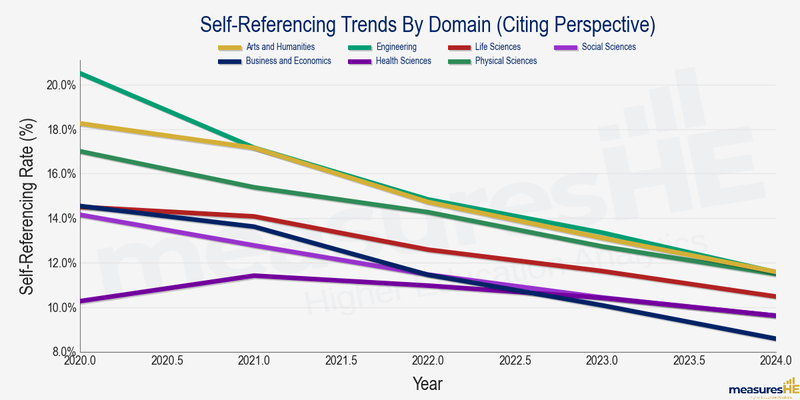
| Subject | 2020 | 2021 | 2022 | 2023 | 2024 |
|---|---|---|---|---|---|
| Arts and Humanities | 18.25% | 17.15% | 14.72% | 13.11% | 11.58% |
| Business and Economics | 14.54% | 13.61% | 11.45% | 10.08% | 8.58% |
| Engineering | 20.50% | 17.16% | 14.84% | 13.35% | 11.57% |
| Health Sciences | 10.27% | 11.41% | 10.96% | 10.41% | 9.61% |
| Life Sciences | 14.50% | 14.07% | 12.58% | 11.62% | 10.47% |
| Physical Sciences | 17.00% | 15.38% | 14.26% | 12.73% | 11.48% |
| Social Sciences | 14.15% | 12.77% | 11.46% | 10.43% | 9.61% |
Interestingly, the Arts and Humanities share a similarly high rate with Engineering. This suggests that the "cumulative" nature of research, where one paper serves as a direct prerequisite for the next, is as prevalent in the iterative development of philosophical arguments as it is in technical hardware development.
While the share of received citations that are "self-inflicted" increases for newer papers, the actual rate at which authors made references to themselves in their own bibliographies has steadily decreased since 2020. This divergence highlights the dual nature of the data. The increasing trend in received citations is a "denominator effect", i.e. the external world simply hasn't caught up with the 2024 papers yet. Conversely, the decreasing trend in citing behaviour reflects a genuine shift in scholarly practice. As we move further from the pandemic-era isolation of 2020, researchers are once again engaging with a broader, more diverse range of external collaborations, reducing their reliance on their own previous datasets.
5. The Matthew Effect: Visibility vs. Validity
The ultimate danger of excessive self-citation lies in the "Matthew Effect" where the rich get richer. By seeding a new paper with early self-citations, authors can trigger discovery algorithms to rank their work higher in search results before the rest of the world has even had a chance to respond.
This initial boost in visibility can lead to more organic citations from others, creating a feedback loop where visibility is mistaken for validity. As we move towards a more data-driven future, the academic community must shift its focus from raw citation counts to "Contextual Bibliometrics," weighting the reason and timing of a citation as heavily as the count itself.
Conclusion
Academic self-citation is a complex, metric-sensitive behaviour. While recent papers may appear to have higher self-citation rates due to the natural lag of external interest, the true test of scholarly impact is whether that work stands the test of time and gains traction beyond the author's own bibliography.
As algorithms play an ever-larger role in research discovery, how can we ensure they distinguish between the "fast" citations of gaming and the "deep" citations of genuine scientific progress?
Key Concepts
| Section | Key Concept | Definition/Data | Implication/Risk |
|---|---|---|---|
| 1. Functionalist Bridge | Legitimate Self-Citation | A prerequisite for scholarly transparency and scholarly continuity. Essential for demarcating new contributions from previous findings and preventing "self-plagiarism". | Acts as a bridge for sequential iterations of knowledge, particularly when reusing unique methodologies. |
| 2. Citation Lag | Time-dependent Rates | Self-citation rates are highest in the first year after publication because authors cite their own new work immediately. | External citations take years to accumulate and "dilute" the initial self-citations, causing the rate to drop over time. |
| 2. Quantitative Data | Global Self-Citation Rate | 12.7% for new papers published in 2024. 10.6% for papers published in 2020. | Highlights the initial metric inflation on recent papers. |
| 3. Organic vs. Gaming | Timescale as a Decisive Factor | Organic: Follows the natural research cycle, citing original work after 12–18 months. Gaming: Occurs almost immediately, using "citation cartels" or "pre-loading" citations in papers/preprints published in the same window. | A high self-citation rate that does not dilute as the paper matures signals potential abuse. |
| 4. Disciplinary DNA | Field Variation (2024 Data) | High Rates (~11.5%): Physical Sciences, Engineering, and Arts and Humanities. Conservative Rates: Health Sciences and Business. | Suggests the "cumulative" nature of research where one paper is a direct prerequisite is prevalent in both technical (Engineering) and philosophical (Arts/Humanities) fields. |
| 5. The Matthew Effect | Visibility Mistaken for Validity | Early self-citations trigger discovery algorithms, boosting search rankings. This creates a feedback loop. | The ultimate danger: Visibility (early ranking) is mistaken for Validity (genuine scientific merit). |
| Conclusion/Recommendation | Contextual Bibliometrics | Focus must shift from raw citation counts to weighting the reason and timing of a citation. | Required for algorithms to distinguish between "fast" citations of gaming and "deep" citations of genuine progress. |
Tags: Academic Fraud Research Integrity Self Citation