World University Rankings Paradox: Research Quality or Quantity?
Feb. 18, 2026 | By David Watkins
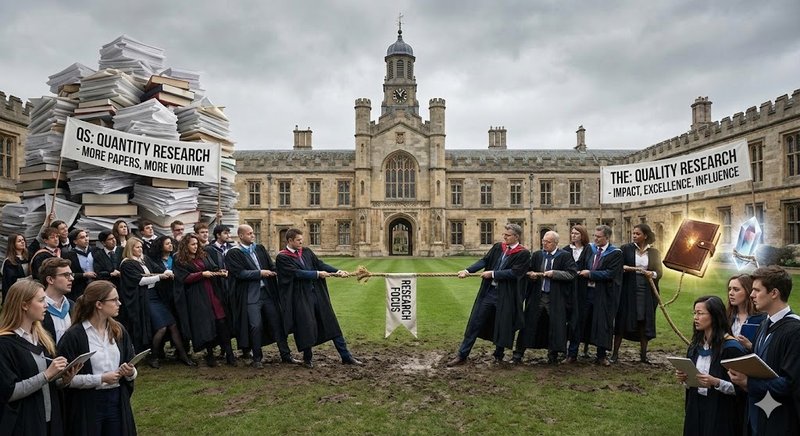
In the hallowed halls of academia, a quiet war is being waged. It is not fought with debates or discoveries, but with spreadsheets and algorithms. The annual beauty parade of global university rankings results in vice-chancellors and strategy directors facing a dilemma that strikes at the heart of higher education: in the race for prestige, does quantity now matter more than quality?
A new analysis of the world’s major university ranking systems suggests the answer is a confusing, contradictory "yes and no." The global higher education sector currently stands at a strategic precipice, balancing the traditional imperative of deep academic inquiry with the pressure to perform in global league tables. While the public often views rankings as a monolithic ladder of quality, a forensic look under the hood reveals that the major players—QS, Times Higher Education (THE), and ARWU (Shanghai)—are measuring entirely different things, often forcing universities into a "bibliometric paradox" where winning in one ranking means losing in another.
The Rules of the Game
To understand the chaos, one must understand the "engines" that drive these rankings. The report identifies a distinct bifurcation in how these agencies treat research output.
On one side sits the QS World University Rankings, described as a "Quantity Engine". Its primary research metric, "Citations per Faculty," calculates success by taking the total number of citations a university produces and dividing it by the number of staff. The maths is simple but profound: because the denominator (faculty) is fixed, every new paper that gets cited adds to the score. There is no penalty for "churning" out extra papers, provided they garner at least one citation. In the QS world, research quantity is rewarded.
On the other side lies Times Higher Education (THE) World University Ranking, historically the "Quality Engine". THE relies heavily on "Field-Weighted Citation Impact" (FWCI), which looks at the average quality of a university's papers. Here, the maths is ruthless. If a university publishes a high-volume of low-quality work, those weak papers drag down the institutional average. A "long tail" of uncited research acts as an anchor, actively destroying the value generated by a university's top scientists. In the THE world, research quality is rewarded over quantity.
Then there is the Academic Ranking of World Universities (ARWU), or Shanghai Ranking. It operates as a "bimodal" engine, rewarding both raw volume and elite exclusivity. Its "PUB" indicator is a simple count of papers indexed in major science journals, directly rewarding the "churn" strategies that THE punishes. However, this is counterbalanced by an incredibly high barrier to entry: 40% of the score is based on Nobel Prizes, Fields Medals, and papers in Nature or Science. For most universities, no amount of volume can compensate for a lack of Nobel laureates.
The "Salami Slicing" Dilemma
This divergence creates perverse incentives for researchers. Take the controversial practice of "salami slicing"—splitting a single coherent study into multiple smaller papers to boost publication counts.
For a university chasing a higher QS rank, salami slicing is theoretically beneficial. If the sliced papers accrue independent citations, the university’s total count rises, boosting its score. However, for a university targeting THE, this same strategy is a disaster. Splitting a high-impact study into three mediocre papers lowers the average impact per paper, crashing the university's FWCI score.
The stakes are even higher with the rise of "paper mills" and predatory journals. While these fraudulent papers might temporarily boost volume metrics—aiding an ARWU "PUB" score—they are "toxic assets" for a university targeting THE. Because these fake papers rarely garner genuine citations, they sit as dead weight in the average, pulling down the ranking.
Quality or Quantity?
This leaves university leaders facing a provocative question: should they chase the research quality or quantity?
The "publish or perish" culture has evolved from a career admonition into an institutional survival strategy. If a vice-chancellor decides to prioritize "quality"—encouraging faculty to spend years on a single, ground-breaking monograph—they risk falling in the QS rankings, which reward the accumulation of citations per author. If they prioritize "quantity"—demanding higher output numbers—they risk tanking their position in THE, which penalizes low citation rates.
The data suggests that a "one-size-fits-all" research policy is obsolete. To optimize for THE, institutions must "prune" their output, culling the long tail of zero-citation papers to promote quality research. To optimize for QS, the focus must be on maximizing total yield per academic head, regardless of how many papers it takes. To rise in ARWU, only raw volume in indexed journals and elite breakthroughs matter.
As the rankings continue to act as "fairground mirrors," each reflecting a different version of success, the academic world is left to wonder: are we measuring what matters, or does what matters simply become what we measure?. University leaders must decide which reflection they wish to optimize, because the maths prohibits them from valuing quality, valuing quantity, and being elite all at the same time.
Tags: Higher Education QS Quality Rankings Times Higher Education Top Universities University World University Rankings