Where do the Stars Align? National Strengths Analysis
March 4, 2026 | By Billy Wong

National research strategies are frequently judged by aggregate metrics: total publication volume, gross expenditure on R&D, or the absolute number of citations. While these provide a sense of scale, they often mask the underlying "talent density"—the concentration of truly elite researchers who drive global intellectual conversations.
The measuresHE Talent 100 2026 provides a more granular lens. By mapping the Top 100 researchers in each of our six subject domains to their primary national affiliation, we reveal where the world's most impactful research talent actually resides. This isn't just a count of papers; it's a map of global expertise.
Key Findings: The Specialised Superpowers
Our analysis shows that while research volume is expanding globally, elite talent remains highly concentrated in specific hubs, often reflecting long-term national strategic investments.
1. China: The Engineering and Physical Sciences Powerhouse
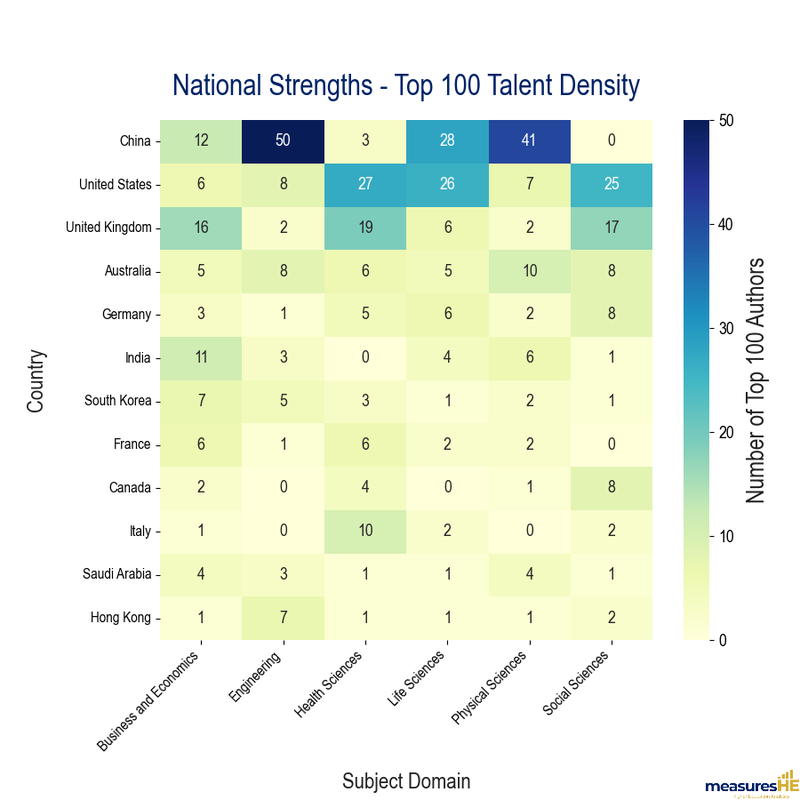
China demonstrates an extraordinary concentration of elite talent in the technical sciences. With 50 researchers in the Engineering Top 100 and 41 in Physical Sciences, China has moved beyond being a high-volume producer to a dominant force in elite technical expertise. This concentration is a clear signal of decades of targeted investment in STEM "mega-projects."
2. USA: The Life and Social Sciences Leader
While the United States (USA) remains competitive across the board, its true elite density lies in the "Human and Life" domains. Leading the world with 27 stars in Health Sciences, 26 in Life Sciences, and 25 in Social Sciences, the US ecosystem remains the primary incubator for scholars who define our understanding of health, society, and the biological world.
3. United Kingdom: The Interdisciplinary Anchor
The UK (GBR) punch significantly above its weight relative to its size, showing a remarkably balanced profile. With strong elite presence in Health Sciences (19), Social Sciences (17), and Business & Economics (16), the UK serves as a critical global node for interdisciplinary and professionally-oriented research.
4. Rising Hubs: India and Australia
Emerging strengths are visible in India (IND), particularly in Business and Economics (11 stars), and Australia (AUS), which shows elite-level competitiveness in Physical Sciences (10) and Engineering (8). These nations are successfully cultivating "pockets of excellence" that rival traditional research superpowers.
Strategic Implications for Policy Makers
For national research directors and policy makers, this "Talent Density" view offers three critical takeaways:
- Avoid the "Volume Trap": High publication volume does not always translate to elite influence. Countries must distinguish between "efficient processing" and "intellectual leadership" in their funding models.
- Strategic Alignment: Talent acquisition must be an intentional extension of the broader institutional strategy. Universities should ensure that the recruitment of elite researchers aligns with their long-term research pillars, ensuring these individuals serve as catalysts for institutional growth rather than operating as isolated prestige-units.
- The Mobility War: Elite talent is highly mobile. National strategies must focus not just on producing stars, but on creating the institutional environments (Research Gravitas) that retain them.
Conclusion
The measuresHE Talent 100 reveals that the "stars" of global research do not align randomly. They cluster around national commitments to excellence, specialized infrastructure, and institutional reputation. For nations aspiring to lead in the 21st-century knowledge economy, the goal is clear: build the density that turns a research hub into a global intellectual anchor.
Tags: Higher Edcuation National Strategy Research Excellence Talent 100