The Research Iron Curtain: Mapping the New Geopolitics of Knowledge
May 4, 2026 | By Billy Wong
For three decades, the global academy lived comfortably within a consensus. We operated on the convenient fiction that science was inherently borderless; that talent would always find its way to the most advanced labs, and that knowledge was a global public good, accelerated by an ever-tightening web of international co-operation. It was a golden age of scientific globalism, where a researcher in Shanghai was, in theory, as connected to a peer in Sheffield as they were to their own faculty colleagues.
But as we unpick the data from the 2026 measuresHE Country 100 ranking, that consensus is fracturing. We are witnessing the descent of a "Research Iron Curtain", a geopolitical fissure that threatens to bifurcate the world’s knowledge production into two increasingly isolated, and potentially incompatible, blocks.
The Collaborative Divide
The most striking observation in this year's metrics is not who is winning, but how they are winning. We are seeing a widening chasm between systems that view international integration as their lifeblood and those retreating into a defensive scientific nationalism. International co-authorship has become the primary predictor of research quality and, more crucially, institutional resilience.
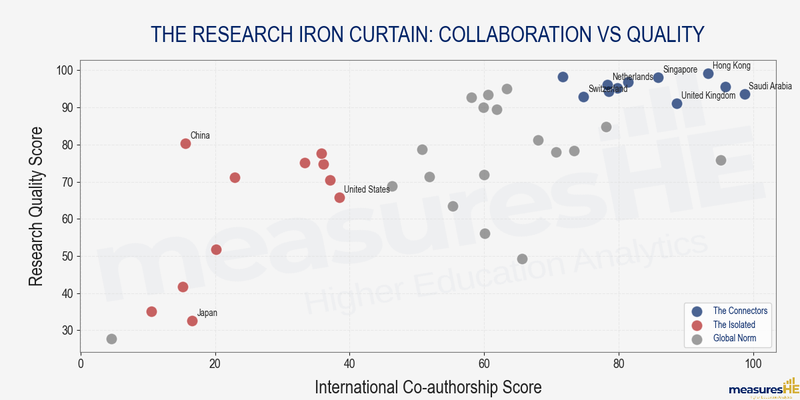
Our analysis identifies the "Connectors", led by the United Kingdom (Rank 1), the Netherlands (Rank 2), and Hong Kong (Rank 9), who have maintained elite research quality precisely by serving as global ports of knowledge. Hong Kong’s resilience is particularly noteworthy. Despite significant local transitions, its scientific "ports" remain open, sustaining world-leading Research Quality (99.2) and Excellence (91.5) by refusing to turn inward.
In contrast, the "Isolated Powerhouses" present a more troubling profile. China (Rank 19) holds a perfect Talent100 score of 100, yet its International Co-authorship has plummeted to 15.6. Similarly, Japan (Rank 27) continues to struggle with "Scientific Galapagos Syndrome" - a system that is high-tech and high-talent, yet fundamentally out of sync with global research trajectories. These are systems that are "leading without followers," producing vast quantities of work that the rest of the world is increasingly unable, or unwilling, to engage with.
The Cost of Decoupling
This decoupling is not a theoretical risk; it is a present reality, most visible in the chilling effect on U.S.-China relations. Following the high-stakes, narrowed renewal of the Science and Technology Agreement (STA) in late 2024, joint research outputs have declined by nearly 20%.
This isolation breeds more than just inefficiency; it opens up an "Integrity Gap." The data reveals a troubling correlation: systems with low international co-authorship scores frequently exhibit significantly higher Research Retraction Rates. China’s retraction score of 65.9 (against a global gold standard of 100) suggests that when you remove the rigorous, cross-border global scrutiny that comes with collaboration, domestic research cultures can quickly descend into "paper mills" that prioritise volume over validity.
The Rise of the New Hubs
As the old superpowers retreat behind national guardrails, a new class of scientific "neutral powers" is emerging. Saudi Arabia (Rank 20) and the United Arab Emirates (Rank 25) have leveraged massive investment and recruitment drives to achieve world-leading collaboration scores of 98.7 and 95.9 respectively. They are positioning themselves as the "Switzerland of Science", vacuuming up talent and quality from both sides of the new Iron Curtain and serving as the essential conduits for global knowledge transfer.
Conclusion: The Great Fragmentation
The Research Iron Curtain does not just block researchers; it blocks the cross-pollination of ideas required to tackle the existential challenges of our century, from the ethics of AI to the next pandemic.
The rankings of the 2030s will not be won by the states with the most authors, but by those with the most "scientific diplomatic ports." In this new geopolitics of knowledge, isolation is the new illiteracy. A nation may build the most advanced labs in the world, but if it retreats behind national walls, a phenomenon increasingly observed in Japan's "Galapagos Syndrome" (Garapagosu-ka), it will eventually lose the global vocabulary needed to participate in the future of science. The curtain is falling; the question is which side we will find ourselves on.
References & Further Reading
- Nature: US and China likely to delay renewal of key science pact again (2024).
- Forbes: From Resorts To Robots: Saudi Arabia's $100 Billion Correction (2026)
- The impacts of internationalization in Japan: a capital-based analysis of international academics (2025).
- Times Higher Education: Metrics obsession is supplanting academic vision in China (2026).
Data Source: measuresHE Country 100 Ranking Table (April 2026).
Tags: Country100 Geopolitics Research Integrity Research Intelligence Research Strategy