The Reach Factor: Are You Trapped in an Echo Chamber?
Feb. 9, 2026 | By Billy Wong

For research leaders around the world, the ultimate goal is not just to be cited, but to be heard globally. You want your research to influence policy in Shanghai, spark innovation in San Francisco, and drive curriculum changes in Stockholm.
But traditional metrics like Journal Impact Factor and FWCI hide a dangerous trap: The Echo Chamber.
These metrics rely purely on the citation counts. However, a journal can have a high citation count even if all its citations come from a small, tight-knit clique of institutions. Publishing there boosts your metrics, but it does not boost your global influence.
Our analysis of the 2026 Journals 100 dataset introduces a critical new metric for university leaders: Diversity of Citing Institutions.
The Echo Chamber vs. The Megaphone
We analyzed thousands of journals to find the difference between "concentrated impact" and "global reach."
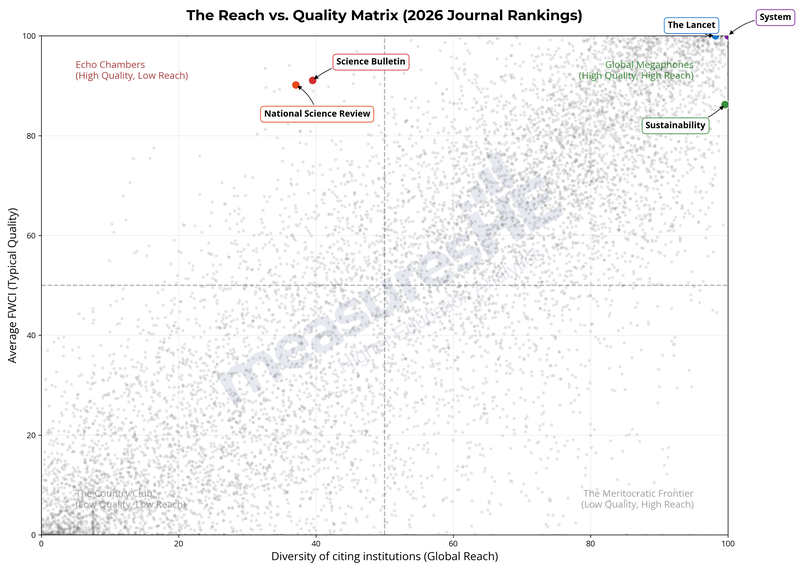
1. The Echo Chambers (High Impact, Low Reach)
We found prominent journals like “Science Bulletin" and "National Science Review" with impressive FWCI scores (>90) but surprisingly low Citing Diversity scores (<40).
- What this means: These journals are generating plenty of citations, but they are coming from a relatively concentrated network of institutions.
- The Risk: If you publish here, your citation count goes up along with your scores from citation-based metrics, but your work effectively stays inside a bubble. You are preaching to the converted. This is "Academic Isolationism" disguised as high performance.
2. The Global Megaphones (High Reach, High Leadership)
On the other end of the spectrum are the "Megaphones"—journals like "The Lancet" (Health), "System" (Linguistics), and "Sustainability".
- The Profile: These journals boast Citing Diversity scores >98.
The Power: When you publish here, citations flow in from every corner of the academic world. Your research is being consumed by a truly global audience. This is the definition of Soft Power.
3. The "Law of Reach"
Is reaching a broad audience actually worth it? Yes.
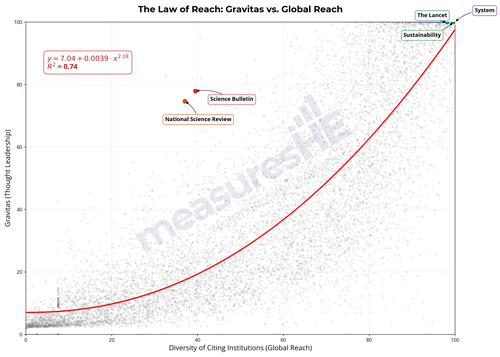
We ran a correlation analysis across the entire dataset and found a massive 0.74 positive correlation between Diversity of citing institutions (Reach) and Gravitas (Thought Leadership).
The Insight: Broad reach is a strong predictor of thought leadership in the field. You cannot lead a subject domain if only your friends are citing you. To become a "Tier 1" research nation, you must migrate your output from "Echo Chamber" journals to "Megaphone" journals.
Strategic Advice for Research Directors
- Audit Your "High Impact" Journals: Don't just look at the JIF or FWCI. Ask: "Where are the citations coming from?" If your faculty is publishing in journals where 80% of citations come from a small number of institutions, you are in an echo chamber.
- Target "Megaphones" for Soft Power: If your national strategy involves increasing global influence (e.g., "World Class University" initiatives), prioritize journals with High Citing Diversity. A citation from a new institution in a new region is worth more strategically than a 10th citation from a local partner.
- Use Diversity as a Tie-Breaker: When a researcher is deciding between two top journals, choose the one with higher Diversity. It ensures their work travels further.
Tags: Diversity FWCI Journal Impact Factor Publication Strategy