The Intellectual Anchors
Feb. 11, 2026 | By Billy Wong

Beyond Citation Metrics: Projecting Your University’s Authority
For University Rectors and research leaders, the pursuit of global standing is often reduced to a single, narrow objective: increasing citation counts. In the race to climb international rankings, Citations-per-Author and Field Weighted Citation Impact (FWCI) have become the default metrics for success.
However, our latest analysis of the 2026 Journals 100 dataset suggests that relying solely on FWCI is a strategic risk. There is a profound difference between a journal that is cited and one that is "foundational." To build a lasting institutional impact, university leadership must look beyond raw citation count and consider Research Gravitas.
Audience Size vs. The Leading Voice
To navigate this landscape, we have categorised journal performance into two primary dimensions that reveal the true nature of scientific standing:
- Field Weighted Citation Impact, or FWCI (Audience Size): This captures the immediate volume of attention. It measures how many researchers are citing the typical paper in a journal relative to the global average. While useful, it is often a noisy metric, susceptible to short-term trends and artificial manipulations.
- Research Gravitas (The Leading Voice): This measures a journal’s structural importance to its field. It evaluates the journal’s role as an anchor, i.e. its ability to define the research agenda and command the respect of the most significant peers in the global scientific community.
Analysis of the 2026 dataset shows a moderate correlation (R2=0.6) between these two measures; generally, a larger audience tends to follow a leading voice. However, for university leadership, the most critical strategic insights lie not in the trend but in the outliers. These “Leadership gaps” represent the decisive territory where a university chooses its future, either to be swept along by the transient noise of the crowd, or to be anchored as a thought leader of the discipline.
The Data: The Leadership Gap
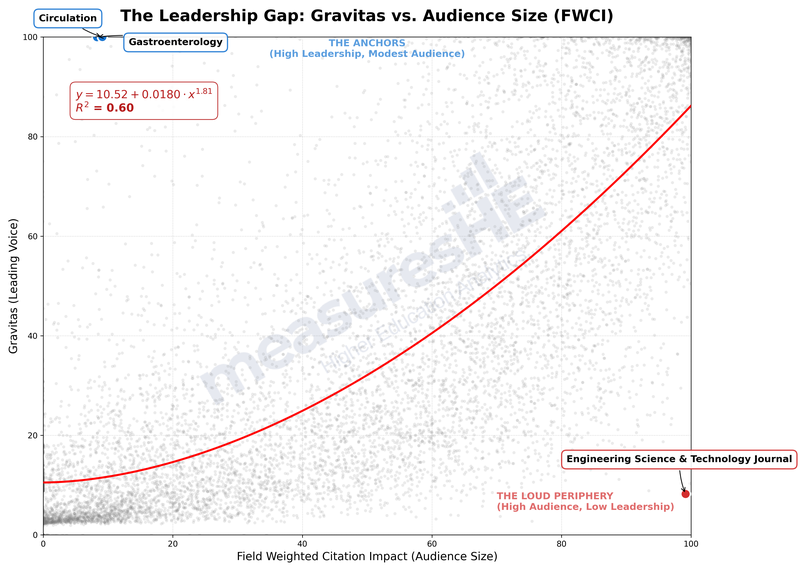
1. The Foundational Anchors (High Gravitas, Modest FWCI)
Titans of medical research such as "Gastroenterology" and "Circulation" display a unique profile. They achieve near-perfect Gravitas scores (99.96 and 99.99, respectively), yet their FWCI scores sit significantly lower (8.3 and 9.1).
- The Strategic Insight: These journals are the bedrock of their fields. They do not need to chase "viral" citation counts; they define what is relevant in their field. A university that publishes here is anchoring its reputation in the very centre of the global establishment, even if the raw citation volume appears lower than that of newer "disruptor" titles.
2. The Loud Periphery (High FWCI, Low Gravitas)
Conversely, journals such as the "Engineering Science & Technology Journal" show an inverted profile:
- FWCI (Audience Density): ~99.1 (An exceptionally high volume of immediate citations).
- Gravitas (The Leading Voice): ~8.2 (A marginal role in the structural leadership of the discipline).
- The Risk: While these venues provide a rapid boost to citation-based ranking points, they often lack the institutional weight required to build long-term prestige. Over-reliance on such titles creates a "shallow" research profile that may be vulnerable if citation patterns shift or metrics are refined.
Strategic Recommendations for University Leadership
- Prioritise Structural Integrity over Raw Visibility: Data analysis of the 2026 dataset shows that high-FWCI "disruptor" journals often operate within institutional "echo chambers." While journals in the "Loud Periphery" achieve high citation volumes, their average Citing Diversity score is only 53.2, compared to 94.9 for top-tier Anchor journals. To build a resilient global reputation, universities must target venues that are integrated into a broad, international network of citing institutions.
- Use Gravitas as a Filter for Research Quality: Raw citation counts can be misleading. High Gravitas identifies journals with a prestigious and globally distributed authoring base. The top 100 journals by Gravitas maintain an average Authoring Diversity score of 90.6, whereas high-visibility journals with low structural weight drop to an average of 37.1. Publishing in "Anchor" journals ensures your faculty’s work is positioned alongside the world’s leading research peers.
- Audit the "Prestige Return" of Your Portfolio: University research offices should evaluate their publication strategy using structural metrics rather than just volume. A single paper in a foundational "Anchor" journal can provide significantly more "Prestige Return" measured by the diversity and weight of the institutions it influences than multiple papers in "Loud Periphery" venues that lack global structural depth.
Tags: FWCI Gravitas Publication Strategy