The Great Citation Heist: How One Academic Hacked the System for 20,000 Fake Citations
March 3, 2026 | By David Watkins
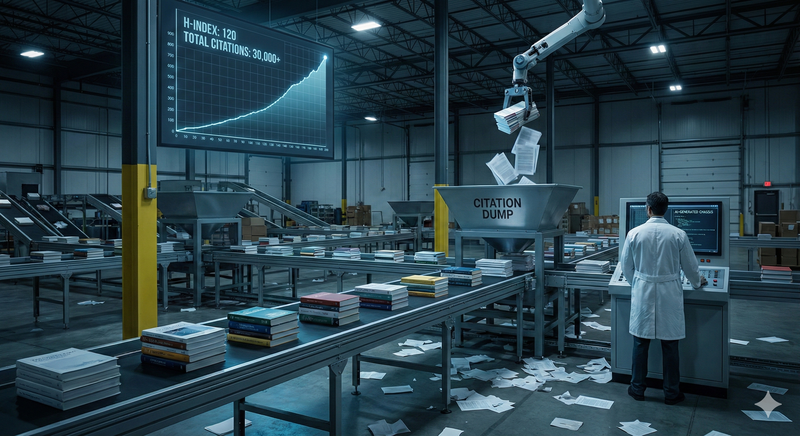
Imagine a researcher with the metric footprint of a Nobel laureate. Now imagine that footprint is nothing but an intricately engineered mirage.
In the cut-throat global academic economy, citations are the ultimate currency; they dictate hiring, multi-million-pound grants, and institutional prestige. But between 2020 and 2024, one academic managed to rig the system on an unprecedented, industrial scale, raking in nearly 30,000 citations.
The catch? Over 20,000 of them were mathematically engineered self-citations.
This wasn’t a glitch. It wasn’t a massive 1,000-person mega-collaboration. It was a calculated, brute-force manipulation of the digital algorithms that govern modern science. Here is exactly how they pulled off the greatest bibliometric heist in recent history.
The Exploit: Weaponising the "Micro-Chapter"
To manufacture 20,000 self-citations in just five years, this individual found a massive blind spot in the academic publishing infrastructure.
Historically, book chapters were ignored by citation algorithms like Google Scholar and Scopus. Recently, however, major publishers began assigning unique Digital Object Identifiers (DOIs) to every single chapter in their edited volumes. Suddenly, algorithms treated a brief book chapter with the same weight as a rigorously peer-reviewed journal article.
The researcher pounced. They secured the position of sole editor for a sprawling, 10-volume encyclopaedic handbook published by a major international publishing house. Instead of filling it with comprehensive, well-researched essays, they fractured the text into more than 700 superficial "micro-chapters".
Why? Because the actual text didn't matter. The text was just a Trojan horse designed to carry a massive payload of self-citations.
The Mathematics of a Scam
By acting as the ultimate editor of the volumes, the researcher completely bypassed traditional peer review. This allowed them to engage in relentless "citation dumping".
The sheer mathematics of the exploit are devastating. Forensic analysis reveals that the researcher authored or co-authored 294 individual micro-chapters that were engineered to cite their own previous work at least 55 times per chapter.
Do the maths: 294 chapters × 55 self-citations = over 16,000 entirely artificial citations generated from this single, co-ordinated tactic. In one particularly brazen chapter, they referenced themselves 83 times.
The AI Accomplice
How does one human being write, edit, and compile hundreds of chapters in such a short window? They don't. They outsource it to artificial intelligence.
Automated text analysis reveals the undeniable fingerprints of unedited generative AI throughout the published handbooks. In fact, the publisher actually printed chapters containing blatant chatbot error messages like "As of my last knowledge update" and "Regenerate response".
The AI was used to churn out grammatically passable "chassis" text in seconds. Once the AI generated the filler, the author manually injected their massive reference list payload. The publisher minted the DOIs, and the fake citations were successfully laundered into legitimate metrics.
Isolated Case or Systemic Issue?
This is the most egregious case we found, but it is far from the only one. Our analysis uncovered thousands of other academics globally who showed very high levels of self-citation that couldn't be explained by rationale such as mega-collaborations.
In one case a researcher had over 300 publications with over 1200 citations, almost all of which had no co-authors. 98.4% of those citations were self-citations.
Separately, three academics had over 25 publications each, no co-authors on those publications, and over 100 citations which were all self-citations.
An Industry Asleep at the Wheel
This scandal isn't just about one rogue academic; it is a catastrophic failure of the multi-billion-pound publishing industry.
Publishers possess highly sophisticated plagiarism software, yet they completely failed to implement rudimentary checks that would flag a 15-page chapter containing 83 self-citations. By prioritising the high profit margins of massive encyclopaedic sets over academic rigour, the industry has become an unwitting accomplice to fraud.
Worse still, this synthetic, AI-generated noise is actively burying genuine research, particularly studies focused on the developing world. If the algorithms that rank our science aren't urgently fixed, the h-index will no longer measure a scientist's brilliance; it will merely measure their audacity in cheating the system.
The Solution
In an era of hyper-authorship and "citation cartels," traditional metrics like raw publication counts and the H-index are increasingly prone to distortion. Our Talent 100 provides a cleaner, more robust approach by employing:
🔹 Research Gravitas: A PageRank-based network analysis that identifies "Intellectual Anchors" rather than just prolific publishers.
🔹 The Olympic Mean: A trimmed-mean approach to FWCI that strips away "blockbuster" outliers to reveal sustained, typical research quality.
🔹 Interaction Credit: A sophisticated correction for hyper-authorship that rewards meaningful collaboration over nominal inclusion in massive consortia.
Tags: Academic Citation Higher Education Self Citation Universities World University Rankings academic reputation