The Great AI Divergence: The East Wins on Volume, But America and Europe Hold the Line on Influence
Feb. 11, 2026 | By David Watkins
A comprehensive analysis of global research output and national strategies reveals a stark new reality: whilst China has definitively won the race for the volume of scientific output, the United States, the United Kingdom, and a select tier of "high-efficiency" economies retain a stranglehold on influence—the ability to define the scientific frontier.
The Volume-Velocity Shift
For decades, the West was the undisputed hegemon of artificial intelligence research. However, data from the last nine years confirms a dramatic usurping of this title.
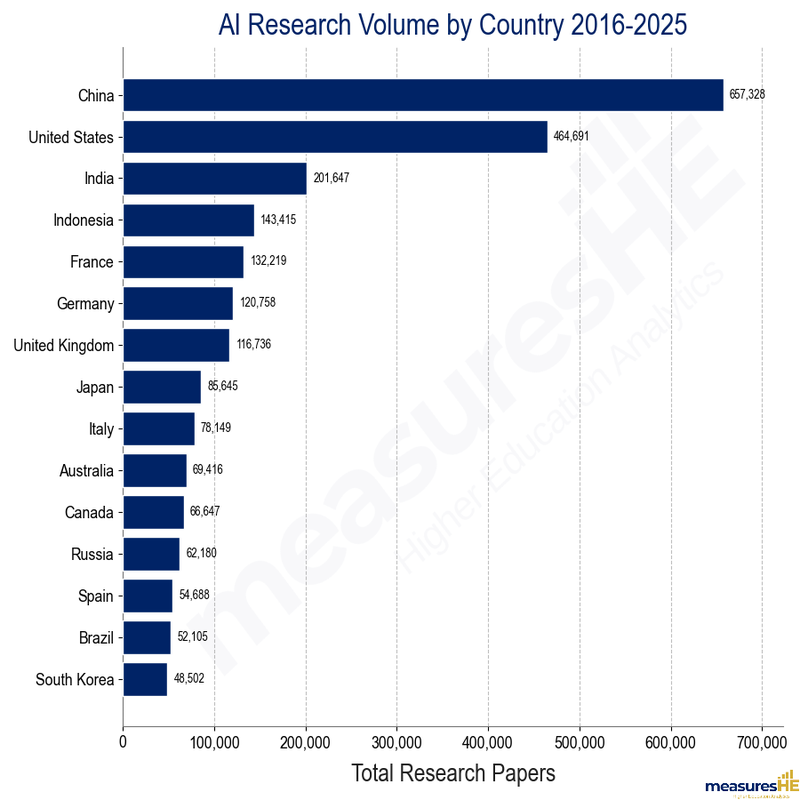
In 2016, the landscape was competitive. The United States produced 37,243 AI-related works, with China following closely at 32,655. The turning point arrived swiftly. Following Beijing's 2017 "New Generation Artificial Intelligence Development Plan," which mobilized the state’s academic apparatus, China’s output surged.
By 2019, China had overtaken the US. Fast forward to 2024, and the divergence has calcified: China produced a staggering 108,578 works—nearly double the output of the United States (55,973).
"Producing high volumes of AI papers is no longer the exclusive domain of developed Western economies," the report notes. "It has become a function of national will". Following in China's wake is the breakout player of the decade: India. Growing its research output by 185% since 2016, India has surged to become the third pole of global AI volume, producing over 33,000 works in 2024.
The Fortress of Influence: The Anglo-American Lead
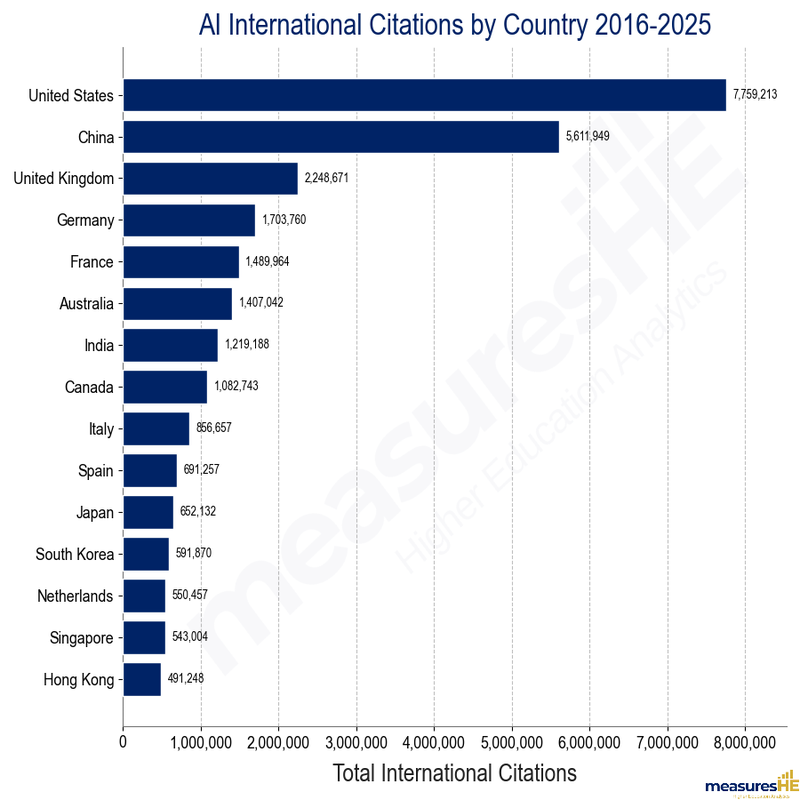
However, quantity is not quality. When analysing the "Sum of International Citations"—a metric that captures how often a country's ideas are utilized by the global scientific community—the picture changes dramatically.
Throughout the rise of Asian volume, the United States maintained a massive "Influence Surplus". Yet, it is the United Kingdom that arguably delivers the most impressive performance relative to its size.
The data confirms the UK’s status as an "AI Scientific Superpower". In 2016, the UK ranked third globally in total influence, garnering 292,359 citations—significantly ahead of Germany and France. Even as global competition intensified, the UK maintained this tier-one status. By 2024, British research continued to punch well above its weight, with a sum of citations (50,699) that surpassed Germany (46,520) and France (26,581), securing its place as the primary European hub for AI influence.
The analysis notes that the UK and US demonstrate significantly higher "Impact Efficiency" than China. Whilst Beijing has flooded the zone with papers, American and British research appears to have a higher "initial velocity"—it is picked up and cited faster by the international community.
The "Boutique" Excellence: Australia and the Golden Triangle
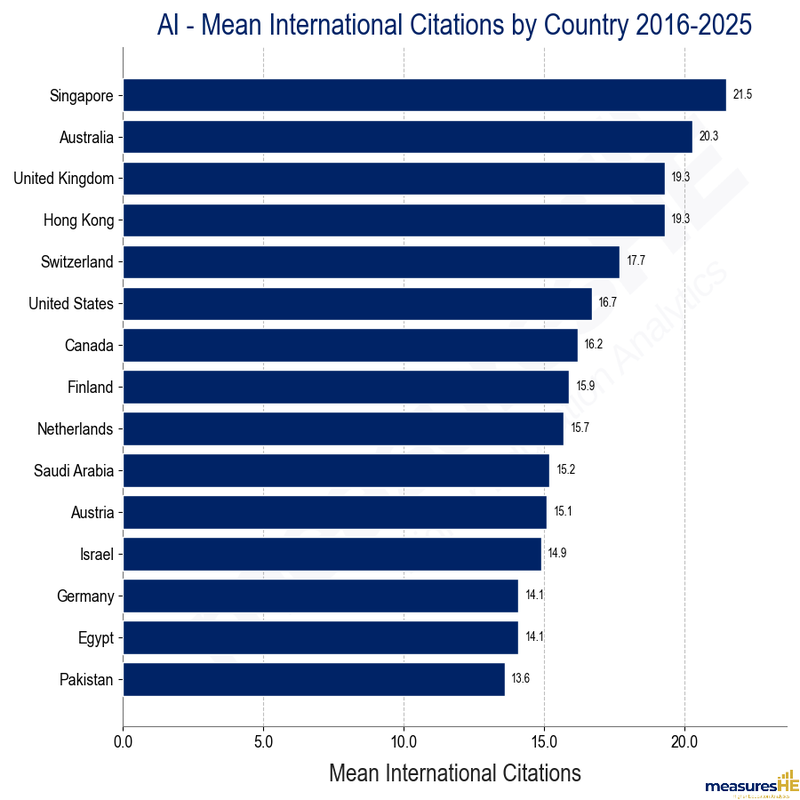
Perhaps the most sophisticated insight emerges when adjusting for per-paper quality ("Mean International Citations"). Here, the superpowers are consistently outperformed by a cluster of highly developed, open economies.
While the report identifies a "Golden Triangle" of Switzerland, Singapore, and Hong Kong, a closer inspection of the data reveals that Australia is a quiet titan in this arena.
In 2016, Australia boasted a mean citation score of 36.64—ranking it well above the United States (32.48) and nearly matching Singapore (37.68). This was no anomaly; Australian research has consistently maintained high average impact scores, often outperforming the "Golden Triangle" members in specific years. For instance, in 2020, Australia's mean citation impact (33.76) remained comfortably ahead of Switzerland (30.84).
These nations succeed through "hyper-collaboration," ensuring their researchers co-author with the best minds globally rather than relying solely on domestic volume.
The Pivot to "Sovereign AI"
As we navigate through 2026, the report identifies a third and final strategic wave. The metric of success is shifting from publishing papers to controlling the physical infrastructure of intelligence.
"The era of measuring AI power by 'paper counts' is ending," the analysis concludes.
Nations are now pivoting toward "Sovereign AI." This shift is characterized by massive state investments not in research grants, but in the "heavy metal" of the AI age: GPUs, data centers, and energy grids.
- The UK has bet its future on being the global "regulator of choice" and the home of AI safety science, evidenced by the establishment of the AI Safety Institute.
- The US has moved to a "Control Phase," utilising export bans to starve rivals of advanced chips.
- China has responded with the "Eastern Data, Western Computing" project, building state-owned compute clusters to survive the blockade.
The verdict of the data is clear: China won the race for volume. The Anglo-American alliance held the fortress of influence.
Tags: AI Influence Research