Hunting for "Young Stars" in Global Research
March 9, 2026 | By Billy Wong
With traditional metrics such as H-Index, seniority is often mistaken for research success. The cumulative effect of a 40-year career can overshadow the emergence of new, high-impact talent. However, for University leaders, the most critical strategic question is not only who is already a leader, but who is becoming one.
In this feature, we analyze the "Young Stars" of the measuresHE Talent 100 2026 - researchers who started publishing within the last 20 years (since 2006) and have already broken into the global Top 100. Identifying these individuals highlights the institutions and nations that are successfully incubating the next generation of research excellence.
The Global Leaders in Talent Incubation
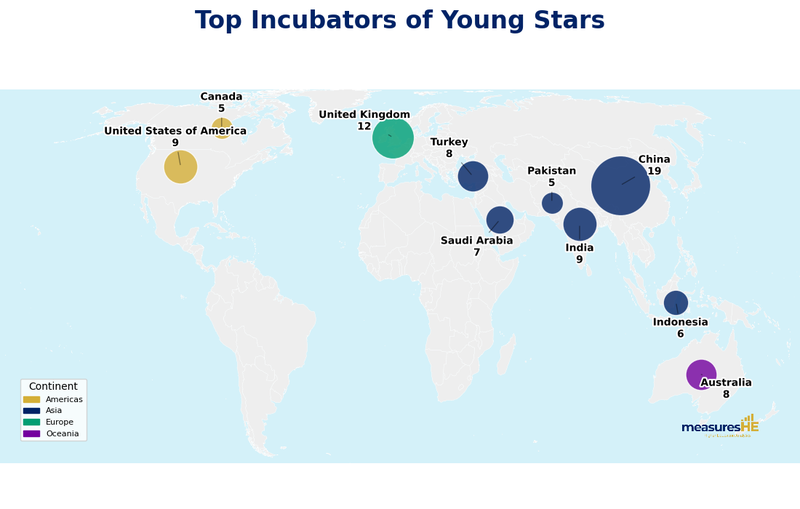
Our analysis reveals where these rising stars are choosing to build their careers. While the United States remains a major hub, the data shows a significant shift in the geography of emerging talent.
Key Findings:
- China leads the pack with 19 Young Stars in the global Top 100, reflecting a massive and successful long-term investment in early-career development.
- The United Kingdom follows with 12 stars, maintaining its status as premier destination for high-potential researchers.
- The United States (US) and India (IN) account for only 9 stars each, behind China.
The Concentration of Rising Talent
While national aggregates show general trends, the distribution of Young Stars across subjects within these nations reveals deeper strategic specialisations.
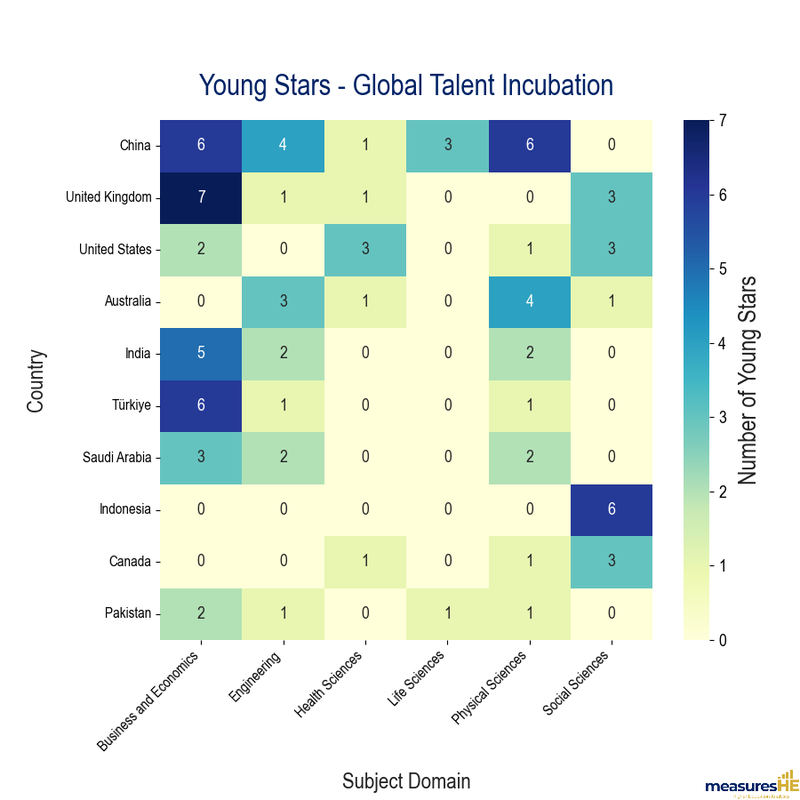
Note: A small number of authors are in the Top 100 in multiple subject domains
China's strength is highly concentrated in Physical Sciences and Engineering. Incidentally they are also subject domains where the US have few Young Stars.
Business and Economics stands out as the primary field for emerging talent, accounting for 42 of the Young Stars in the global Top 100. This represents nearly one-third of all Young Stars across the six subjects. This concentration suggests shorter citation cycles or a highly dynamic global environment that allows new ideas—and their authors—to rise more quickly than in more traditional fields like Life Sciences (13 stars) or Health Sciences (14 stars).
Strategic Implications for University Leaders
For VCs and Research Directors, the "Young Star" analysis provides a blueprint for competitive recruitment and retention:
- Benchmarking the Pipeline: Is your institution successfully supporting researchers to reach elite status within 20 years of their first publication? A lack of Young Stars in your faculty may signal a pipeline problem.
- Targeted Recruitment: Countries like India and China are currently "talent factories" for these rising stars. Universities looking to bolster their future Gravitas should look to these regions for strategic hires.
- Disciplinary Agility: The rapid rise of talent in Business and Economics suggests these departments can significantly boost an institution's global profile in a relatively short timeframe compared to capital-intensive fields like Engineering.
Conclusion
The future prestige of a university depends on its ability to identify and nurture the next generation of leaders. By focusing on "Young Stars," the measuresHE Talent 100 provides leaders with the data needed to move beyond historical reputations and build a faculty that will define the research landscape for the next two decades.
Tags: