Ghost Affiliations
May 29, 2026 | By Billy Wong
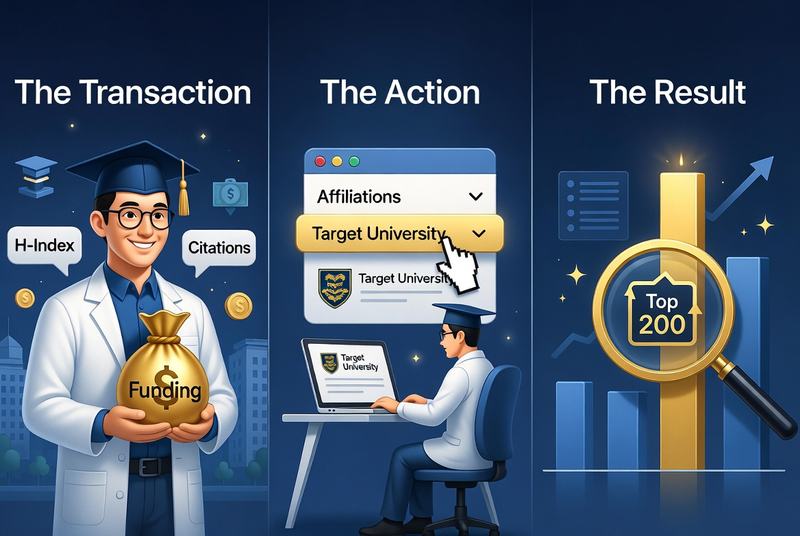
It was a wet dreary April afternoon in London. A mysterious email arrived, but the deal was sealed in a nondescript coffee shop on the other side of town the following week. Over a quiet handshake, a transaction was finalised between a representative from an ambitious mid-tier East Asian university and 'Professor D', a mathematics researcher whose exceptionally high Field-Weighted Citation Impact (FWCI) made him a superstar.
The university had an impressive campus, a substantial budget and a highly driven president, but its global ranking was stagnant. The offer was simple: Professor D did not need to move his lab. He did not need to teach. He did not even need to visit the country. For a generous annual stipend, he simply had to list the university as one of his affiliations on his future publications.
Professor D accepted. For the next three years, he became a 'ghost' on a campus 6,000 miles away. In the metadata of the world’s leading journals, he was a faculty member; in reality, he never left his own office. This is the 'mercenary' market of academic prestige, a shadow economy where the currency is citations and the goal is a higher rung on the global university rankings.
The Integrity Crisis in Global Rankings
For university leaders, global rankings are more than just vanity metrics. They dictate international student recruitment, government funding, and institutional survival. Because both Times Higher Education and QS rankings are heavily weighted toward citation impact, a single 'Highly Cited Researcher' can move an institution up fifty spots in the global pecking order.
However, this pressure has created a systemic integrity risk: Affiliation Gaming. Institutions are increasingly 'renting' the names of high-impact scientists to harvest their citation credits. Our deep-dive into global bibliometric data (2020-2024) reveals a disturbing pattern of non-collaborative appointments that exist only on paper.
The 'Smoking Gun': The Co-authorship Void
To identify these mercenaries, we look for the Co-authorship Void. In a legitimate academic appointment, a researcher works with their local community - mentoring PhD students, collaborating with professors, and using local facilities. This results in 'co-authored' papers where both the star researcher and local colleagues are listed.
A 'mercenary' researcher, however, lists the university on their paper while every single one of their co-authors is from somewhere else. They have a total void of local collaboration.
A Global Arms Race for Prestige
The industrial scale of this bibliographic inflation is powered by an elite cadre of 'Super Ghosts', highly efficient mercenaries who credit at least twenty separate publications to a purchasing institution within a five-year window. Our analytical models have pinpointed 283 Super Ghosts who serve as the primary engines of synthetic prestige for nearly 280 institutions worldwide. One particularly egregious case involves a Lebanese institution simultaneously renting the impact of 11 different Super Ghosts. Conversely, the most active mercenary identified, a specialist in International Finance, successfully monetized his scholarly profile across seven different universities during this timeframe.
While our analytical models identify the specific individuals and institutions involved in these practices with granular precision, we have purposefully chosen to anonymise the data in this report. Our objective is to raise awareness of a systemic integrity crisis and encourage a cultural shift across the sector.
Impact
The influence of Super Ghosts extends beyond mere citation enhancement; they significantly distort the research output metrics of purchasing universities. An average Super Ghost working for a Lebanese university inflated the publication volume by over 110 publications within a five year period.
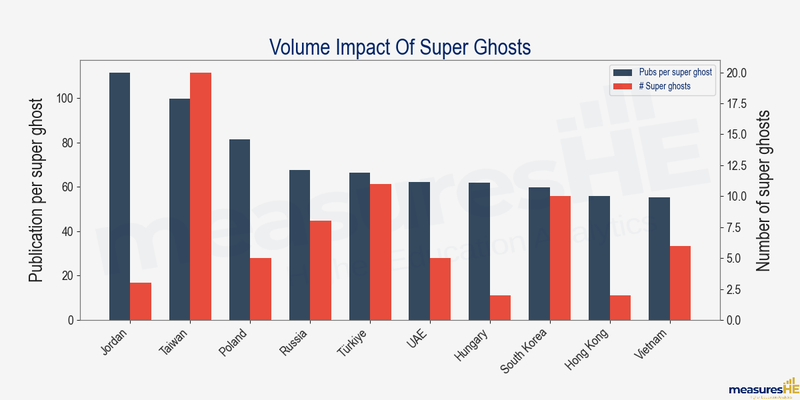
The most pronounced instances of volume inflation are found within specific regions of East Asia and the Middle East.
- East Asian Technical Hubs: High intensity of 'prestige-for-hire', with an average of 46.6 ghost works per mercenary researcher.
- Middle Eastern Emerging Markets: Systemic reliance on non-resident HCRs to drive rapid ranking gains, with void rates consistently exceeding 94%.
- Central and Eastern European Clusters: Increasing prevalence of 'guest' appointments in engineering and materials science with near-total co-authorship voids.
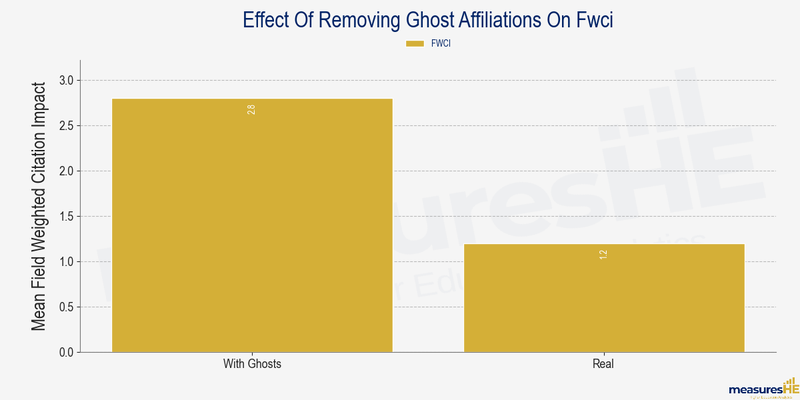
However, the much bigger impact is in the distortion of research quality. When we audit one institution and remove the impact derived from ghost researchers, their citation scores take a nosedive. In some cases, an institution’s reported performance drops by 40% to 60% once the 'ghosts' are removed.
Conclusion: Sustainable Excellence vs. Temporary Gains
For a Vice-Chancellor or Rector, the temptation to 'buy' a ranking boost is understandable. But an affiliation without a single co-authored paper is a commercial transaction, not an academic appointment.
Relying on mercenaries creates a hollow reputation that is vulnerable to public exposure and data audits. The danger is especially pronounced due to the growing use of analytical methods applied to bibliometric databases.. True institutional gravitas is built on the hard work of developing local talent, fostering genuine global collaboration, and maintaining the highest standards of academic integrity. In the long run, the 'ghosts' will disappear, and they will take your university's reputation with them.
Tags: Bibliometrics Data Analytics Research Integrity Research Strategy