Ending of the "Free Ride"
March 9, 2026 | By Billy Wong
In certain scientific disciplines, most notably the Physical Sciences, the phenomenon of "hyper-authorship" has long posed a challenge for evaluative bibliometrics. When a single paper lists hundreds, or even thousands, of authors (as is common in High Energy Physics or Large-Scale Observational Astronomy), the traditional "equal credit" model breaks down.
The measuresHE Talent 100 addresses this by introducing the "Collaboration Intensity" metric. By using a sophisticated fractional counting method called "Interaction Credit," we can distinguish between researchers who lead or significantly contribute to small-to-medium teams and those who are part of massive consortia where individual contribution is necessarily diluted.
The Analysis: Physical Sciences
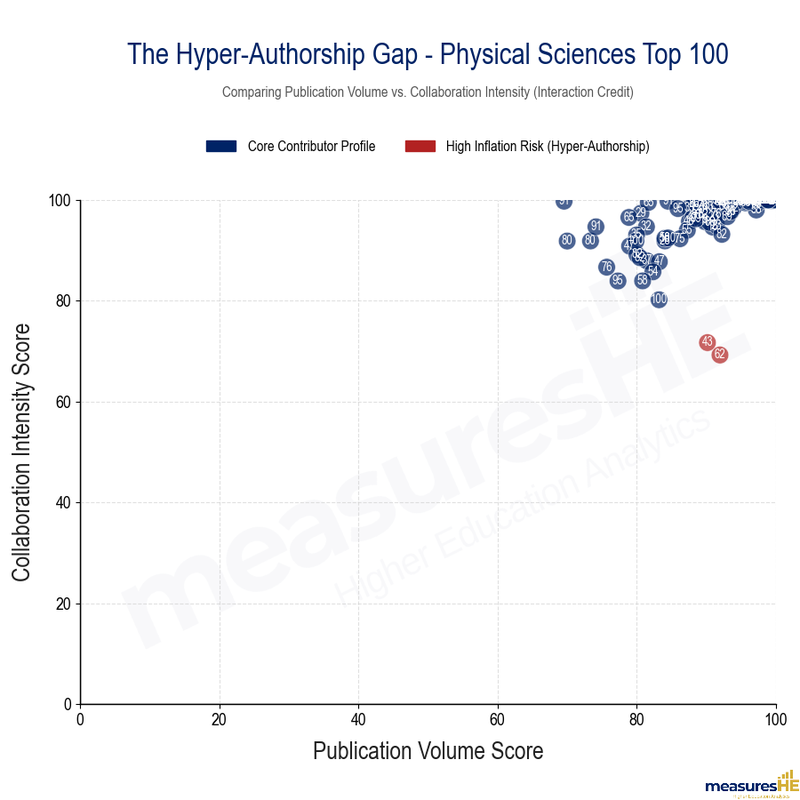
We examined the Top 100 ranked scholars in Physical Sciences for 2026. By comparing their Publication Volume Score (based on raw count of papers) against their Collaboration Intensity Score, we can identify those whose rankings might be "inflated" by hyper-authored outputs.
Key Insights
1. The "Free Ride" Outliers (Crimson)
A small number researchers in the Top 100 show a significant "Inflation Risk", i.e. a large gap between their raw volume and their collaboration share. These individuals are often part of the world's largest research collaborations. While their work is undeniably excellent (they are, after all, in the Top 100), our metric reveals that their individual "Interaction Credit" is lower than their volume suggests. We identified 2 major outliers with inflation risks exceeding 15 points.
2. The Core Contributors (Royal Blue)
Conversely, many Top 100 Physical Scientists maintain a near 1:1 ratio between volume and collaboration intensity. These "Core Contributors" primarily publish in small-to-medium teams, where their individual impact on each paper is more substantial and direct. Their scores are "solid". They collaborate but are not reliant on massive group counts to maintain their elite status.
3. Institutional Strategic Alignment
For Research Directors, understanding this gap is vital for fair talent evaluation. If a university's talent profile is heavily weighted toward "Hyper-Author" outliers, the institution's global standing may be vulnerable to shifts in how collaborations are credited by funding bodies and ranking providers.
Conclusion
Correcting for hyper-authorship is about acuracy, not penalising "Big Science". By separating volume from meaningful contribution, the measuresHE Talent 100 provides a more granular and honest view of who is actually driving research forward. In the era of the thousand-author papers, recognising individual contributions is as just important as encouraging collaborations. The shared glory of mega research consortia should not be confused with individual achievements.
Tags: Gaming Hyper-authorship Research Excellence Talent Strategy